



Woodward-Service Bulletin 01671
Service Bulletin 01671
ProTech GII, TPS, and MSM
User Configuration Guidance
Issue
ProTech GII, TPS, and MSM controls support a variety of configuration options. When using
Active speed probe sensors, certain configurations could lead to a lapse in overspeed protection,
if multiple faults occur in the system comprised of the ProTech, field wiring and speed sensors.
Description
The ProTech GII, TPS and MSM are fault tolerant safety control devices that are fully configured
by customers for each unique site application. These products have many functional options
available and the system is designed to continually provide its primary function, even when one
fault occurs anywhere in the ProTech system.
It has come to our attention that some user configurations of these products, may not react as
expected when a second fault occurs in the ProTech system.
These safety products are all configurable by the user, so it is important to emphasize the
following points:
• On any configurable device – it is possible to have a valid configuration that may not do all
that is expected, verification of customer and installers requirements and unit testing at site
commissioning is required to ensure the appropriate response to faults in the system.
• On any fault tolerant system, a single fault should be investigated and addressed. Depending
on the configuration, running the system in a prolonged mode with an active alarm, leaves it
in a state where a second fault could cause a trip or prevent the unit from performing its
primary function.
If your configuration settings utilize one of the following features, this Service Bulletin can be
disregarded:
1. Probe Type: PASSIVE (such as MPU’s)
2. Speed Fail Trip: USED
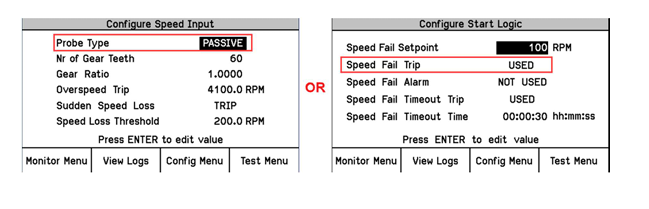
If your configuration settings are using Active probes (not MPU’s) and your configuration has Speed Fail Trip
set to “NOT USED” follow the instructions in the Corrective Action section below.
All units shipped with the following part numbers:
GII
TPS
MSM
8237-1244 8237-1248 8237-1252
8237-1245 8237-1249 8237-1253
8237-1246 8237-1250 8237-1254
8237-1247 8237-1251 8237-1255
8237-1367 8237-1371 8237-1375
8237-1368 8237-1372 8237-1376
8237-1369 8237-1373 8237-1377
8237-1370 8237-1374 8237-1378
8237-1594 8237-1602 8237-1492
8237-1595 8237-1603 8237-1493
8237-1596 8237-1604 8237-1494
8237-1597 8237-1605 8237-1495
8237-1598 8237-1606 8237-1496
8237-1599 8237-1607 8237-1497
8237-1600 8237-1608 8237-1498
8237-1601 8237-1609 8237-1499
8237-1660 8237-2602 8237-2492
8237-2594 8237-2603 8237-2493
8237-2595 8237-2604 8237-2494
8237-2596 8237-2605 8237-2495
8237-2597 8237-2606 8237-2496
8237-2598 8237-2607 8237-2497
8237-2599 8237-2608 8237-2498
8237-2600 8237-2609 8237-2499
8237-2601 8237-2614
Potentially affected ProTech units may have also shipped as sub-components of other Woodward
cabinets, kits and systems. Specific customer sales order details are provided by the appropriate
Woodward Customer Service Representative.
If you are currently using configurations described above then at your earliest convenience, plan
to modify your unit configuration with the following recommendations.
It is recommended that on ProTech GII products, the option Speed Fail Trip always be set to
“USED” whenever the configuration of the speed input probe type is “Active”.
It is recommended that on ProTech TPS or MSM products, the option Speed Fail Trip always be
set to “Used” whenever the configuration of the speed input probe type is “Active”. If this is not
desired, due to a need to have other Safety Instrumented Functions (SIF) protected in all 3
kernels, then use the “Speed Redundancy Management” option and configure both “Base
Function” and “Fallback Function” to be HSS.
To review their ProTech configuration and compare it with the information in this bulletin to see if
any of these potential problem conditions are possible.
We suggest that customers with units that are currently in operation, to verify that they are not
running with active module alarm conditions that could lead to a potential issue.