



GE Digital Energy D20 Analog Input Module
GE Digital Energy D20 Analog Input Module
Overview
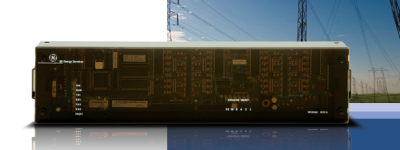
The D20 Analog module is composed of two detachable modules, WESTERM D20 A and WESDAC D20 A.
The bottom module, WESTERM D20 A, is where all field wirings are terminated. The top module, WESDAC
D20 A, processes the data acquired and communicates this to the main D20 processor, see Figure 2.
The WESTERM D20 A is the termination module for the WESDAC D20 A analog input module. All field,
I/O, and power terminations for the WESDAC D20 A are made on the WESTERM D20 A. Up to 32 analog
inputs can be accommodated on compression type terminations. Through the use of input adapter
modules, individual inputs can be configured for voltage or current. Voltage ranges currently accepted
are 1. 5 or 10 volt full scale unipolar or bipolar. Current inputs are sampled via a shunt resistor and
therefore almost any common current range can be accepted. A wetting source is supplied for current
loop inputs.
Capacitors and varistors are equipped to provide Surge Withstand Capability (SWC) as well as impulse
protection on all field inputs. Loop voltage for field transducers can be provided on an individual input
basis. The voltage source can be either the input to the WESDAC D20 A or an external source.
Two DB 9 connectors are provided to allow daisy chaining of the D.20 Link. This link provides the
communication channel over which the main D20 CPU processor, the WESDAC D20 M, can communicate
with the WESDAC D20 A. Power for the WESDAC D20 A is also provided over the same cable assembly.
The power is fused and filtered by passive components on the WESTERM D20 A.
A single DB 9 connector is provided for the WESMAINT D20 maintenance port. This port allows
communications between a VT 100 terminal or emulator, and the WESDAC D20 A. Module input data as
well as diagnostic information can be viewed over the maintenance port. The address jumper block for
the WESDAC D20 A is located on the WESTERM D20 A. The address on the jumper block corresponds to
the module’s address on the D.20 link.
The WESDAC D20 A is physically mounted on and electrically connected to the WESTERM D20 A through
three 40 pin connectors. The two modules are mounted on a 19 inch rack and all field terminations are
wired into the WESTERM D20 A.
Only passive components are mounted on the WESTERM D20 A leaving all the active components on the
WESDAC D20 A. This arrangement simplifies in field repair of the unit since the WESDAC D20 A can be
replaced without disturbing any of the field wiring.
D20
Distributed I/O Architecture
The D20 Remote Terminal Unit (RTU) design is based on a distributed
processing architecture including real-time data acquisition and control
software. These I/O modules can be located close to the primary equipment
being monitored and controlled as they receive and send data back to the
master D20 main processor.
The I/O modules are intelligent modules that contain on-board
microprocessors and are configured as slave devices to the D20 main
processor. In the Figure 1 pictorial setup, specific I/O processing is distributed
throughout the D20 RTU to the appropriate I/O modules.
The I/O modules support two communication protocols: (1) DNP 3 protocol,
and (2) high speed, high-level data link controller (D.20 Link, HDLC) protocol.
The peripheral modules have serial communication ports and various types
of field connections.
The hardware construction of each remote I/O module type is similar (see
Figure 2.)
D20
Data Processing
D20 I/O peripherals provide specialized processing and storing/buffering
functions for analog inputs/outputs by gathering data from field sources or
acting as an output unit to interface with field devices.
I/O processing provides flexible, reliable, robust operation and is configurable
on a per-point or per-system basis.
The D20A is capable of processing standard voltage and current inputs
continuously. It supports the following:
• Programmable Input Ranges: A programmable gain instrument amplifier
permits programming of voltage input ranges. Ranges are stored in RAM
on a per-point basis. (+/- 1. +/-5. +/- 10 V scale).
• Variable Scan Rate: Programmable scan rate from 17.2 to 20.5 ms (50/60
Hz) on a per module basis.
• 32 Differential Analog Inputs and eight internal references using
synchronous integrating-type analog-to-digital (A/D) converters.
• A/D Conversion provides excellent normal-mode rejection characteristics
while maintaining very good response times (approximately 550 ms total).
Termination Types
D20 Analog I/O module can be ordered with the following field termination
options: