



GE 531X305NTBAJG1 NTB/3TB Terminal Board.
531X305NTBAJG1 Technical Specifications
Model Number 531X305NTBAJG1
OEM GE Motors and Industrial Systems
Product Type Terminal Board
Frequently Asked Questions about 531X305NTBAJG1
What is a 531X305NTBAJG1 Terminal Board?
The 531X305NTBAJG1 is a NTB/3TB Terminal Board that was manufactured by General Electric for DC300 and Mark V applications.
The 531X305NTBAJG1 is specifically a “J” revision and will serve as a suitable replacement for any NTBA Terminal Board that uses backwards compatibility.
What is the instruction manual for the 531X305NTBAJG1?
The GE Instruction Manual for the 531X305NTBAJG1 NTB/3TB Terminal Board is GEI-100020B and is available upon request from AX Control.
What does the 531X305NTBAJG1 Interface with?
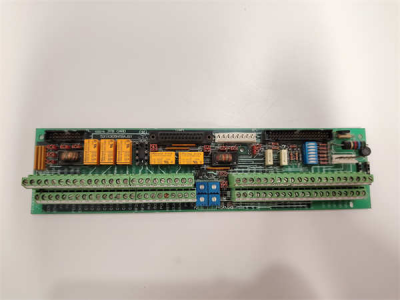
531X305NTBAJG1
The 531X305NTBAJG1 NTB/3TB Terminal Board provides the following interfaces:
· Power supply
· Encoder
· RS-232C and RS422
· Relay Outputs
· Analog Tach and Reference coarse scaling
· Low-level analog I/O
· Digital control inputs
About the 531X305NTBAJG1
531X305NTBAJG1
The General Electric 531X305NTBAJG1 card was developed to function as an NTB/3TB terminal board.
This card was manufactured with the 531X series of replacement drive and exciter boards.
A number of critical device features are provided when this board is installed.
Some of the interfacing capabilities of the card include relay and serial outputs, power supplies, encoders, and analog I/O.
A number of important features are provided to the host drive from the NTB/3TB terminal board.
When installed, the 531X305NTBAJG1 card can produce regulated output supplies rated at 5 VDC and 15 VDC.
Unregulated supplies of 24 VDC and 120 VAC are also produced by the board.
Jumpers on the card also allow for interfacing configuration for 5 V and 15 V encoders.
Within the board are seven relays that are either form C or form A output types.
Each relay features a contact fating of 120 VAC. Four potentiometers are also found on the board.
These allow for low level analog I/O scaling to occur.